
When most people hear the word therapy, they picture two people sitting in chairs talking.
While talk therapy is incredibly effective for many people, it isn’t the only path toward healing. Sometimes our experiences, emotions, and memories are difficult to put into words. Other times, we understand what happened to us but can’t quite explain how it continues to affect us.
That’s where sandtray therapy can become a powerful tool.
At Kindred Quest Therapy, sandtray therapy offers clients of all ages a way to express themselves creatively, safely, and without needing to have all the “right words.” Whether someone is four years old or forty-four, the sand can become a place where stories, emotions, and healing naturally emerge.
What Is Sandtray Therapy?
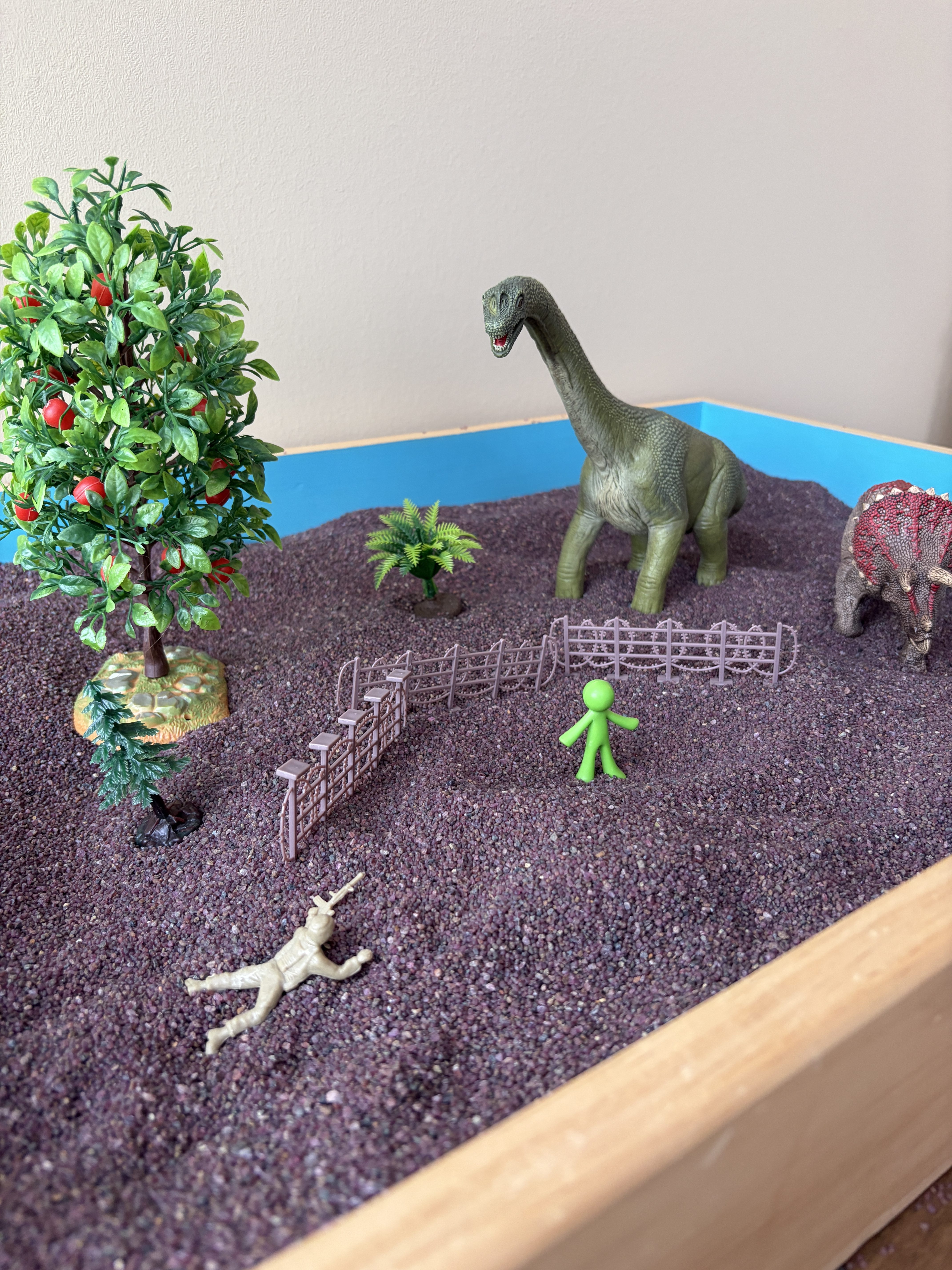
Sandtray therapy uses a shallow tray filled with sand along with miniature figures representing people, animals, fantasy characters, buildings, nature, vehicles, symbols, and everyday objects.
Clients are invited to create a scene in the sand using whichever miniatures feel meaningful to them.
There is no right or wrong way to build a sandtray.
Some people carefully create detailed worlds. Others simply place a few figures in the sand. Some trays tell a story. Others capture a feeling that words cannot.
The therapist does not tell the client what to build. Instead, the sandtray becomes a safe place for exploration, reflection, and emotional expression.
Why Does Sandtray Therapy Work?
Our brains naturally organize experiences through images, symbols, stories, and relationships, not just language.
Many difficult experiences are stored in parts of the brain that are less verbal. Trauma, grief, anxiety, attachment wounds, and overwhelming emotions can sometimes be difficult to explain, even when we know they’re affecting us.
Building a scene in the sand allows the brain to organize these experiences visually and symbolically.
The process often helps clients:
- Express emotions that feel difficult to say aloud
- Gain insight into patterns and relationships
- Explore problems from a safe emotional distance
- Process trauma without needing to recount every detail
- Strengthen creativity and problem-solving
- Build a greater sense of emotional regulation
The tray becomes a bridge between internal experiences and external understanding.
Sandtray Therapy for Children
Children naturally communicate through play.
Just as adults often process experiences through conversation, children process their world through imagination and symbolic play.
A child may not say:
“I’m anxious about my parents’ divorce.”
Instead, they may build a world where two kingdoms are separated by a river and a small dragon keeps traveling back and forth between them.
Rather than asking children to explain feelings they may not fully understand, sandtray allows them to communicate in the language they already know.
Sandtray therapy can help children experiencing:
- Anxiety
- Trauma
- Divorce or family changes
- Grief
- ADHD
- Autism spectrum differences
- School difficulties
- Emotional regulation challenges
- Attachment concerns
The therapist follows the child’s lead while helping them develop safety, confidence, and emotional resilience.
Sandtray Therapy for Teens
Teenagers often live in two worlds.
Part of them wants independence.
Another part struggles to describe what they’re feeling.
Many teens say things like:
- “I don’t know.”
- “I’m fine.”
- “It’s hard to explain.”
Sandtray therapy removes some of the pressure to find perfect words.
Instead of talking about difficult experiences immediately, teens can create a symbolic representation of what life feels like.
This often leads to conversations that feel more natural, less overwhelming, and surprisingly insightful.
Sandtray can be especially helpful for teens navigating:
- Anxiety
- Depression
- Identity exploration
- LGBTQ+ experiences
- Social stress
- Trauma
- Family conflict
- Self-esteem concerns
Sandtray Therapy for Adults
One of the biggest misconceptions about sandtray therapy is that it’s “just for kids.”
In reality, adults often find sandtray incredibly meaningful.
Life experiences become complicated.
Relationships are layered.
Trauma isn’t always easy to describe.
Sometimes adults discover insights through a tray that they had never considered while simply talking.
The process can gently access emotions, memories, and beliefs while allowing clients to stay grounded and in control.
Adults frequently use sandtray while working through:
- Childhood trauma
- Complex PTSD
- Anxiety
- Relationship patterns
- Grief
- Life transitions
- Parenting challenges
- Identity development
- EMDR preparation and processing
Many clients are surprised by how much meaning can emerge from arranging simple miniature figures.
Is Sandtray Therapy About Interpreting Symbols?
This is a common question.
Movies sometimes portray therapists assigning secret meanings to every object in a tray.
Real sandtray therapy doesn’t work that way.
Rather than assuming what a miniature means, therapists stay curious.
A castle might represent safety for one person.
For someone else, it might represent isolation.
Healing comes from discovering your meanings—not someone else’s interpretations.
At Kindred Quest Therapy, we believe each person’s story belongs to them.
Our role is to help create a space where that story can unfold safely.
Sandtray and Trauma Healing
Sandtray is especially effective when working with trauma because trauma often affects parts of the brain that don’t rely primarily on language.
Instead of forcing clients to explain painful experiences before they’re ready, sandtray allows healing to happen gradually through symbols, relationships, imagination, and emotional safety.
For many clients, this feels less overwhelming than trying to “tell the whole story.”
When appropriate, sandtray can also work beautifully alongside EMDR, expressive arts therapy, and other trauma-informed approaches.
What Sandtray Looks Like at Kindred Quest Therapy
At Kindred Quest Therapy, sandtray is never something clients are required to use.
Instead, it’s one of many tools available on the journey toward healing.
Our therapy room includes a carefully selected collection of miniature figures representing a wide variety of people, cultures, families, occupations, fantasy creatures, animals, buildings, nature, emotions, and symbolic objects. This diversity helps clients create worlds that feel authentic to their own experiences and identities.
Sometimes a client spends an entire session building in the sand.
Sometimes the tray becomes part of a larger conversation.
Other times it supports EMDR or play therapy by helping clients organize emotions visually before moving into deeper processing.
Whether you’re bringing your child to therapy, you’re a teenager looking for a different way to express yourself, or you’re an adult who feels stuck despite years of talking through problems, sandtray offers another path toward understanding yourself with curiosity rather than judgment.
Healing doesn’t always begin with finding the right words.
Sometimes it begins by creating a world in the sand.
Ready to Begin Your Quest?
If you’re looking for a child therapist, teen therapist, or trauma therapist in Edina, Minnesota, Kindred Quest Therapy offers sandtray therapy alongside play therapy, EMDR, and expressive approaches designed to meet each client where they are.
Healing isn’t about saying everything perfectly.
Sometimes the first step is simply creating a space where your story can take shape.
